Categories
Animal Emotions Ethics

The five Ps: the advantages of considering emotions

revised February 2025.

4384424_s
Crouching… or fearful?

Is the dog depicted above crouching, or fearful? 

Yes, I know, it’s nigh impossible to guess which emotional state an animal is in from a still picture. We need motion, and context, to be able to do that.

I guess what I’m really asking is: do you look at animals and see predominantly their behaviour, or do you take a stab at considering their emotional/mood state?

In this blog post, I hope to convince you to develop the second perspective, if you haven’t already.

In other words, I would encourage you to start using emotion labels – one of the three types of useful labels when it comes to animals and their behaviour.

The world of animal trainers is divided, and I find that some trainers avoid the subject of animal emotions altogether.

“There’s no need to factor in and understand emotions, just deal with the observable behaviour”, is the gist of what some trainers and animal professionals say.
Categories
Animal Emotions Ethics

Why you should behave as if animals have feelings even if you don’t believe that they do.

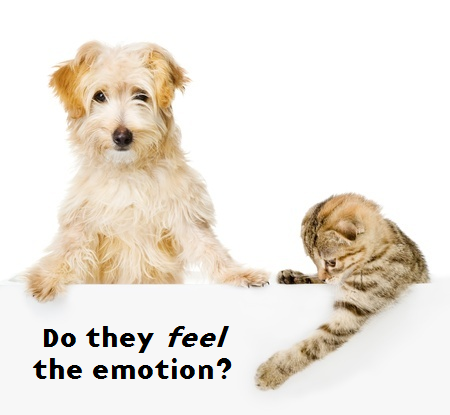
Do animals have emotions: can they experience the same subjective feelings of fear, rage and joy that humans can?

feeling emotions

A seemingly straightforward question, and one that I recently asked on Facebook.

Here’s what you answered, Facebookers:

Categories
Animal Emotions Dealing with fear

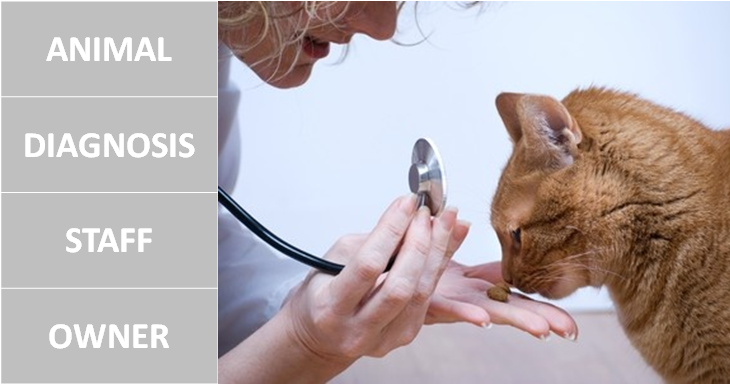
4 compelling reasons to feed treats at the vet’s

This post is part of a series on addressing animals’ fear in the veterinary clinic.

Why feed treats? The technical term is counterconditioning (CC), and it’s about feeding fabulous treats in order to reduce fear.

feeding
Categories
Animal Emotions Dealing with fear Problem Solving

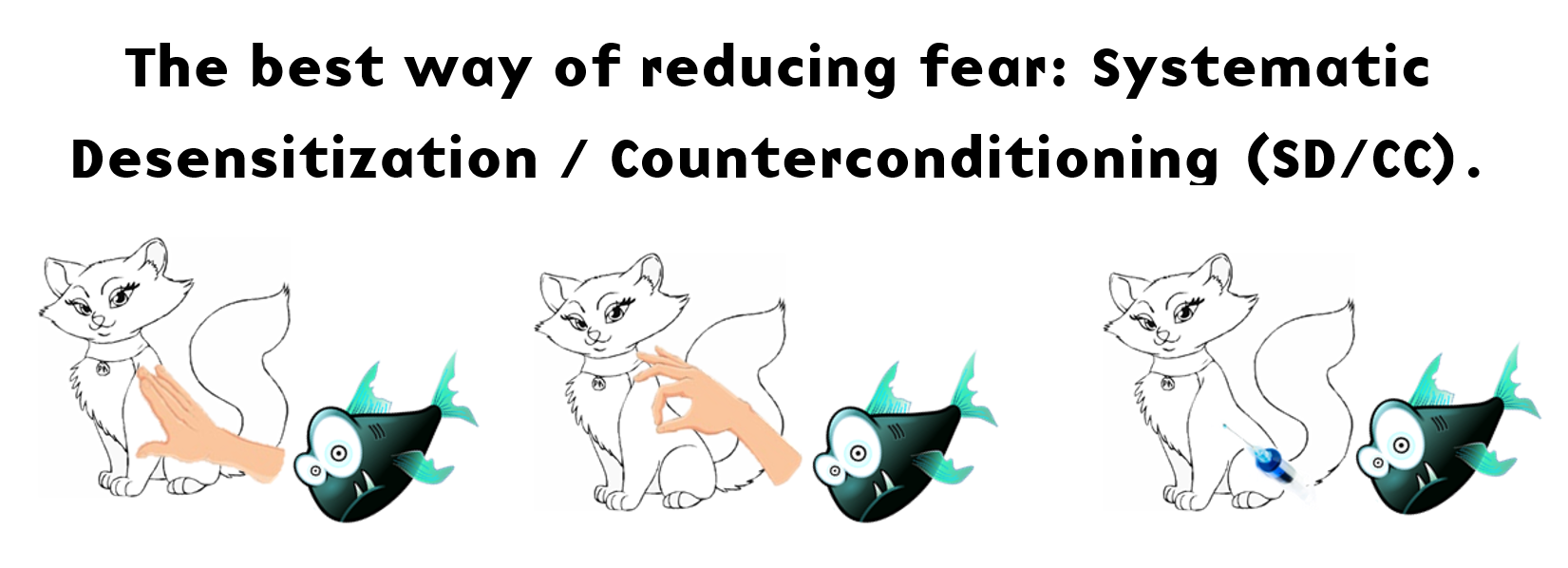
The golden combination to prevent and reduce fear: systematic desensitization / counterconditioning (SD/CC)

In previous posts, I have described systematic desensitization (SD – introducing scary things gradually), and counterconditioning (CC), learning to associate potentially aversive stimuli with something nice.

The combination procedure is called SD/CC, DS/CC or CC/D depending on who you’re talking to; some people skip the first word of SD and only talk about desensitization. The procedure looks the same, though: after each exposure to the stimulus, the animal gets something it really likes.

The basic SD/CC to teach a cat to accept an injection may look like this – note that there may be up to 20 intermediate steps between each of these (for instance, when introducing the needle):

  • Stroking the cat, then giving it some tuna.
  • Stroking more firmly – more tuna.
  • Lifting the skin – tuna again.
  • Pinching – tuna.
  • Needle prick – tuna.
  • Injection – tuna…

But remember, do not move on to the next step until you see that the animal is completely comfortable and at ease at the current step (the relaxation part of SD) and is looking for the tuna (showing signs of learning the association: CC).

In short, this type of procedure is typically not done in one single session but over several training sessions.

SDCC
Categories
Animal Emotions Dealing with fear

Dog owners: to pet or not to pet during thunderstorms or fireworks.

Revised August 2019.

Depending on who you ask, you get a vastly different answer to the question of whether it’s a good idea to pet a frightened dog (or other animal with whom you have an established relationship and that enjoys your touch) during noisy (scary) events.

In the scientific literature, the overwhelming majority of articles (if not all…?) recommend not petting, meaning that petting fearful dogs inadvertently reinforces the anxious behaviour.

Still, in the dog training community, many professional dog trainers do recommend petting an anxious animal, and it has been argued that “petting doesn’t reinforce fear, it reduces it”.

Does petting reduce fear – or reinforce it?

So which is it? Could both sides have a point?

Categories
Animal Emotions

A challenge to dog owners – join the experiment!

Wanna join this experiment on the effect of tone of voice on dog behaviour? Please share what you found with us in the survey!