… Is your dog afraid of fireworks? How about thunder?
Keep reading, this blog post contains everything you need to know.
… Is your dog *not* fearful of fireworks, thunder or other loud noise?
Keep reading anyway. That may change, and you should be prepared. What’s more, you can prevent it from ever becoming an issue.

This post is updated about twice a year, last on May 31st, 2026 – look for the “revised” signs in the post to find the latest changes.
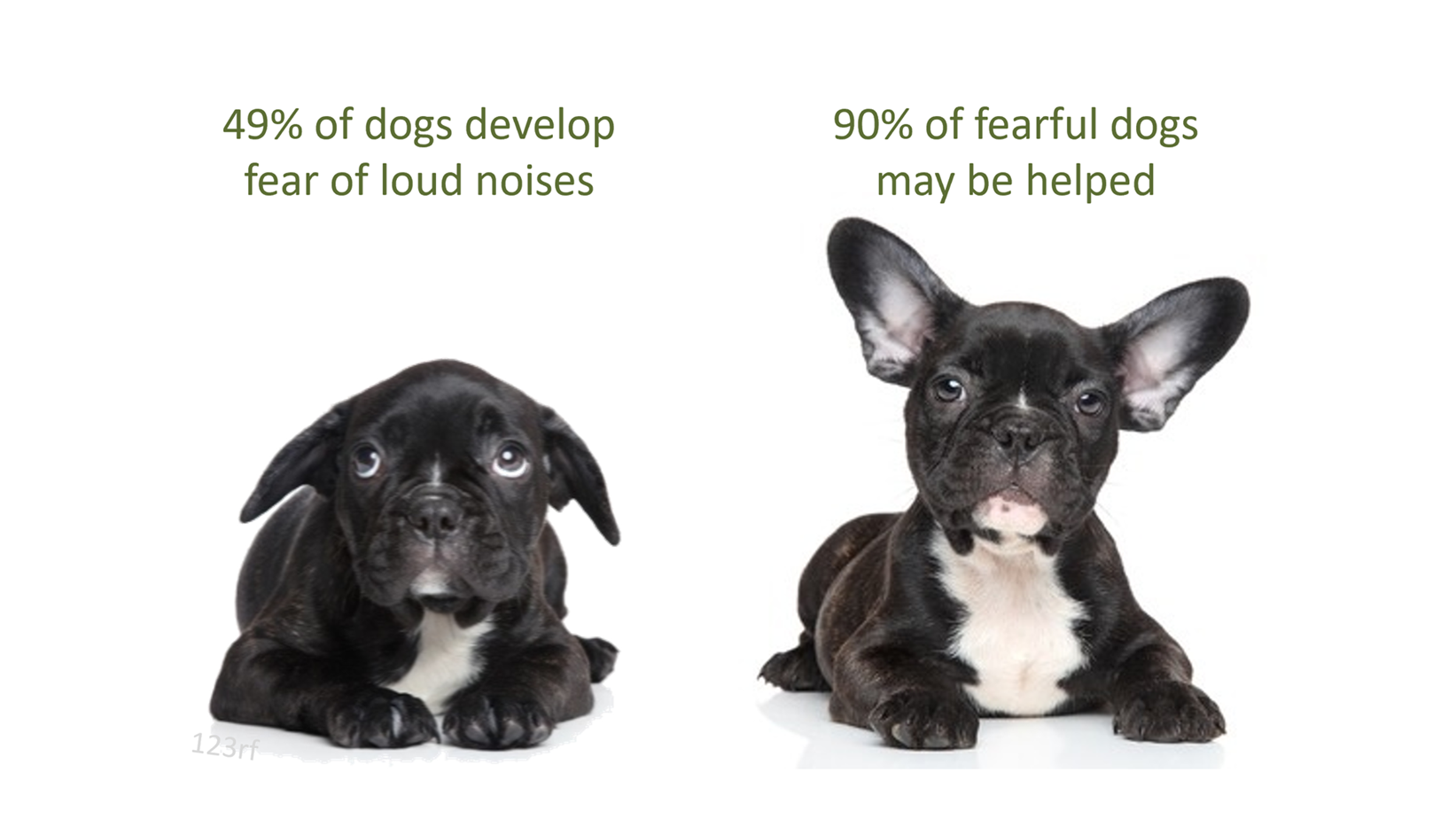
It’s the combination of different techniques that produce the best effect (Crowell-Davis et al., 2003: 93%). Nobody’s tried using all the techniques suggested in this blog post, as far as I know.
Is the noise starting already? Jump straight to what to do now.

The combination procedure is called SD/CC, DS/CC or CC/D depending on who you’re talking to; some people skip the first word of SD and only talk about desensitization. The procedure looks the same, though: after each exposure to the stimulus, the animal gets something it really likes.
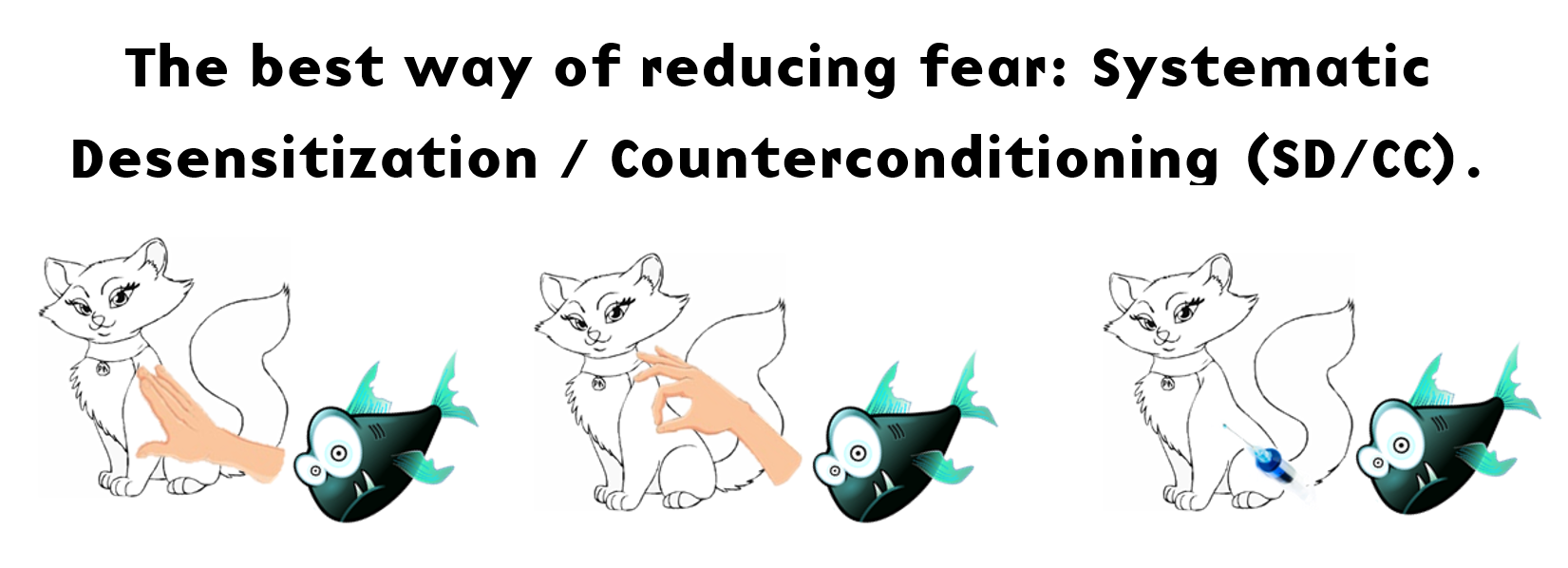
The basic SD/CC to teach a cat to accept an injection may look like this – note that there may be up to 20 intermediate steps between each of these (for instance, when introducing the needle):
Stroking the cat, then giving it some tuna.
Stroking more firmly – more tuna.
Lifting the skin – tuna again.
Pinching – tuna.
Needle prick – tuna.
Injection – tuna…
But remember, do not move on to the next step until you see that the animal is completely comfortable and at ease at the current step (the relaxation part of SD) and is looking for the tuna (showing signs of learning the association: CC).
In short, this type of procedure is typically not done in one single session but over several training sessions.
As I updated this blog post, I recorded it. So, you can either watch it, or read the whole thing below the video!
Let’s say there’s a thunderstorm, and your dog creeps up to you, pressing against you, seeking comfort.
Should you pet him?
The hundred-dollar question.
Depending on who you ask, you’ll get a vastly different answer to the question of whether it’s a good idea to pet and comfort an animal when they’re scared.
Many people recommend not comforting them, saying that petting fearful animals inadvertently reinforces the fear.
Others say that that’s nonsense, and that you should absolutely offer comfort to your animal companion when they’re scared. This group might say that petting doesn’t reinforce fear, it reduces it.
Does petting reduce fear – or reinforce it?
So which is it? Could both sides have a point?
I would say yes they do – and they’re both wrong, but not for the reason you might think.
My verdict: please offer comfort (including petting*) to your animal when they’re fearful, but be observant: there’s three different mechanisms that might make their fear worse (just not through the process of reinforcement).
*assuming the animal knows you and they enjoy being petted under normal conditions
Systematic desensitization is an essential part of your toolbox to reduce and eliminate fear.
I know, ten syllables. And yet, it’s one of the most important tools in animal training, so… let me explain it, and perhaps it will be easier to digest.
If you’ve read my other posts in this series, you know I’ve been promoting counterconditioning (or re-learning) as one of the best techniques to reduce fear in the veterinary clinic.
You might be thinking: “Aaaaw, that’s too much of a hassle, there’s no time. Why not just grab the animal, do what needs to be done, and with time, the animal will get used to it? It will habituate.”
There are four reasons why I don’t think that’s a good idea:
If it works, it’s a slow process
Meanwhile, you risk injury in staff handling the animal and difficulty in diagnosis.
You run the risk of sensitization (the animal becoming successively more fearful)
You risk confusing successful habituation with learned helplessness (animals giving up; a potentially pathological reaction)