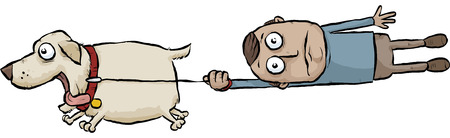
I collaborate with a vet who claims that many of the dogs that visit her facility are so eager to get inside the door that they pull their owners by the leash all the way from the parking lot.
Her secret?
*drumroll*
Coun-ter-con-di-tio-ning.
Six syllables. I know, most people tune out beyond four. But I still think you should learn this particular term. Why?
Because it’s one of the most important techniques in animal training (arguably top five).
Counterconditioning may be the difference between your dog eagerly pulling to get to the vet’s, or shaking like a leaf on the examination table.
When updating this blog post, I recorded it. So, if you prefer to sit back and watch or listen, go get your favorite hot beverage! Or just read on for the full text…
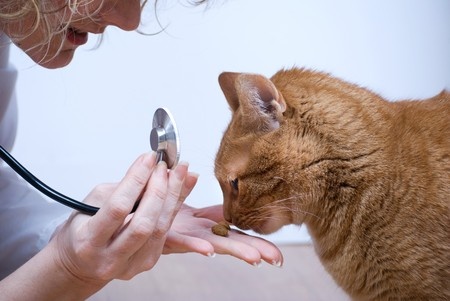
Is your dog or cat offered treats during the visit to the veterinarian?
I think they should be – but I can also think of two reasons why this might not happen.
Scenario 1: The vet is unfamiliar with how extremely useful treat feeding is in preventing, reducing and eliminating fear in the veterinary clinic. After all, it’s traditionally not something they’ve learned in vet school (although thanks to organizations like Fear Free certifying over 100.000 veterinarians and pet professionals, that’s now rapidly changing!)
Scenario 2: The vet doesn’t dare feed treats in case the animal needs to be sedated, thinking that “animals need fasting before sedation”.
Feeding treats at the vets is not coddling – it’s a way to prevent and reduce fear.
For decades, I’ve been teaching about fear, anxiety and stress (FAS) in pets during veterinary visits. Among several topics, I’ve spoken about why treat feeding, using counterconditioning, is such a powerful technique to reduce and eliminate – and prevent – fear and fear learning.
But in the various groups of veterinarians and vet technicians I’ve lectured to over the years, I kept hearing the same objections over and over again:
“That sounds great”, the vets would say. “But if we need to sedate them, we can’t feed them immediately before we put them under”.
They were referring to the unfortunate risk of a sedated animal getting Gastro-Esophageal Reflux (GER; stomach content getting back up in the food pipe), resulting in Aspiration Pneumonia (AP; that same stomach content ending up in the lungs and causing chemically induced pneumonia), which might be lethal for dogs (but incidentally, not a big problem with cats, apparently).
– But the choice is between TWO treatments. .!
In other words, the vets I spoke to looked at counterconditioning as a treatment with potentially serious side effects, and they chose not to use it.
And my issue with that choice is that not feeding treats is also a treatment, and it also has potentially serious side effects.
But it always seemed to me that the vets I spoke to would only acknowledge the first treatment, not the second.
As if “not giving treats” was doing nothing.
Full disclosure: I’m not a veterinarian myself – my background is in ethology, with a special focus on emotions, learning and wellbeing. And, in my mind, “not offering treats in the veterinary clinic” might potentially stress animals out big time – which can have devastating health and behavioural effects.
This looks like a classic Catch-22 type of situation, doesn’t it, with only bad options:
either we feed treats, and risk the animal dying when – if – sedated
or we don’t feed treats, and risk the animal stressing out completely
Those vets’ unwillingness to try counterconditioning got me curious, and I started asking questions:
How soon before sedation can we feed, then?
What if you just feed a teeny weeny little tidbit?
How about broth – liquids surely must have really short gut passage time?
How big is the increase in risk if you do feed a small amount before sedating?
How dangerous are the complications, anyhow – could the benefits be worth the risk?
As a scientist, my knee-jerk reaction was to look for the article that addressed those questions.
I didn’t find one. There wasn’t any. Nobody had looked at that!
So I did. And in my quest for the Truth, I came to realize that the apparent choice was a false dichotomy.