(originally written in 2015, revised May 2026)
Is your dog or cat offered treats during the visit to the veterinarian?
I think they should be – but I can also think of two reasons why this might not happen.
- Scenario 1: The vet is unfamiliar with how extremely useful treat feeding is in preventing, reducing and eliminating fear in the veterinary clinic. After all, it’s typically not something they learn in vet school (although thanks to organizations like Fear Free certifying over 100.000 veterinarians and pet professionals, that’s now rapidly changing!)
- Scenario 2: The vet doesn’t dare feed treats in case the animal needs to be sedated, thinking that “animals need fasting before sedation”.
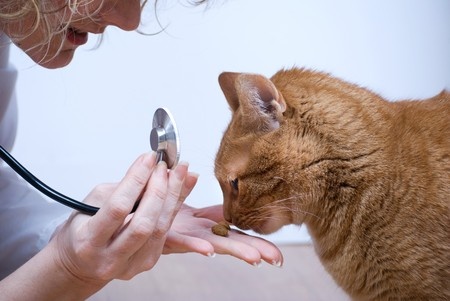
For decades, I’ve been teaching about fear, anxiety and stress (FAS) in pets during veterinary visits. Among several topics, I’ve spoken about why treat feeding is such a powerful technique to reduce and eliminate – and prevent – fear and fear learning. This is called counterconditioning.
But in the various groups of veterinarians and vet technicians I’ve lectured to over the years, I kept hearing the same objections over and over again:
“That sounds great”, the vets would say. “But if we need to sedate them, we can’t feed them immediately before we put them under”.
They were referring to the unfortunate risk of a sedated animal getting Gastro-Esophageal Reflux (GER; stomach content getting back up in the food pipe), resulting in Aspiration Pneumonia (AP; that same stomach content ending up in the lungs and causing chemically induced pneumonia), which might be lethal for dogs (but incidentally, not a big problem with cats, apparently).
– But the choice is between TWO treatments. .!
The vets I spoke to looked at counterconditioning as a treatment with potentially serious side effects, and they chose not to use it.
And my issue with that choice is that not feeding treats is also a treatment, and it also has potentially serious side effects.
But it always seemed to me that the vets I spoke to would only acknowledge the first treatment, not the second.
As if “not giving treats” was doing nothing.
Full disclosure: I’m not a veterinarian myself – my background is in ethology. And, in my mind, “not giving treats in the veterinary clinic” will potentially stress animals out – which can have devastating effects, both with regards to health, not to mention behaviour.
This looks like a classic Catch-22 type of situation, doesn’t it, with only bad options:
- either we feed treats, and risk the animal dying when – if – sedated
- or we don’t feed treats, and risk the animal stressing out completely
Those vets’ unwillingness to try counterconditioning got me curious, and I started asking questions:
- How soon before sedation can we feed, then?
- What if you just feed a teeny weeny little tidbit?
- How about broth – liquids surely must have really short gut passage time?
- How big is the increase in risk if you do feed a small amoung before sedating?
- How dangerous are the complications, anyhow – could the benefits be worth the risk?
As a scientist, my knee-jerk reaction was to look for the article that addressed those questions.
I didn’t find one. There wasn’t any. Nobody had looked at that!
So I did. And in my quest for the Truth, I came to realize that the apparent choice was a false dichotomy.
Is it reeeeeeally a catch-22 situation?

Would it be possible to get the benefit of the treat “treatment” – but without the risk of side effects? A happy animal that doesn’t run any increased risks when – if – sedated?
Well, I don’t know about you, but me, when faced with an intriguing question like that, I tend to dig in and do some some research.
Back in 2015, when faced with this dilemma, I ended up publishing a scientific paper in the Journal of Veterinary Behaviour.
In this blog post, I summarize my main conclusions – and expand on them a bit.
I plowed through every study I could find on risks associated with feeding and sedation. Most studies are on dogs or people, by the way. And yes, the complications related to sedation are potentially extremely dangerous, even lethal.
Surprisingly, I found nothing in the scientific literature supporting the decision to stay away from treats – I could even argue the opposite: it might be more risky not to use counterconditioning before sedation (and through no less than four mechanisms, which we’ll get to in a moment). Sedation is always a risk, but there’s nothing to indicate that it would be riskier to countercondition the animal using small amounts of fluid treats even close to the moment of sedation – if you do it right.
But first, what actually happens?
Fasting, GER and AP.
You might think that the more recently someone ate, the more likely they are to get Gastro-Esophageal Reflux (GER) when sedated.
Well… no. It’s not at all straightforward. Just behold this graph:
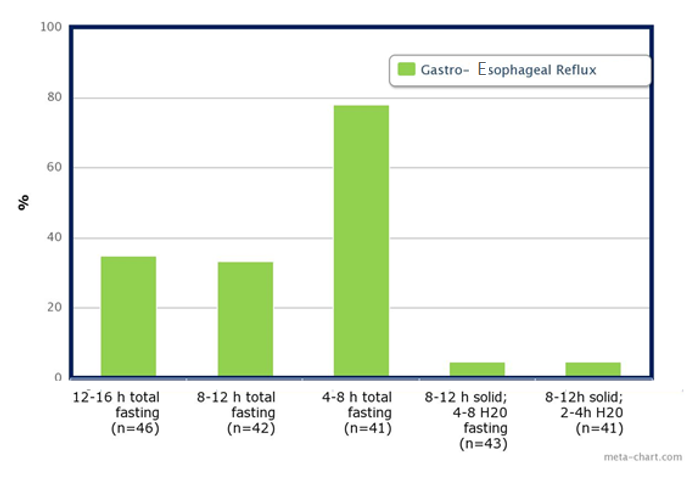
According to the diagram above, there is no apparent relationship between how long the animal has fasted and how big the risk of GER is. Indeed, the lowest risk of GER is seen in dogs who have received water up to 2 hours before anesthesia. Note that this study didn’t cover any treatment involving fluids or small food amounts offered right up to the moment of sedation, so we lack data on that important interval.
Still, if the animal regurgitates, things could get really serious if gut content ends up in the lungs – Aspiration Pneumonia (AP) could set in.
Also, the risk of AP correlates with how much content is in the stomach at the time of regurgitation, so the major issue is not when the animal last ate, but how much content is in the stomach at the time of sedation.
Now, you may think that there’s a correlation between those two – “if the animal ate recently, he must have more food in the stomach” – but when the animal last ate is not at all as important as what the animal ate – or his current emotional state, which affects gut motility.
Let me illustrate this with a fancy schematic image of the gut:
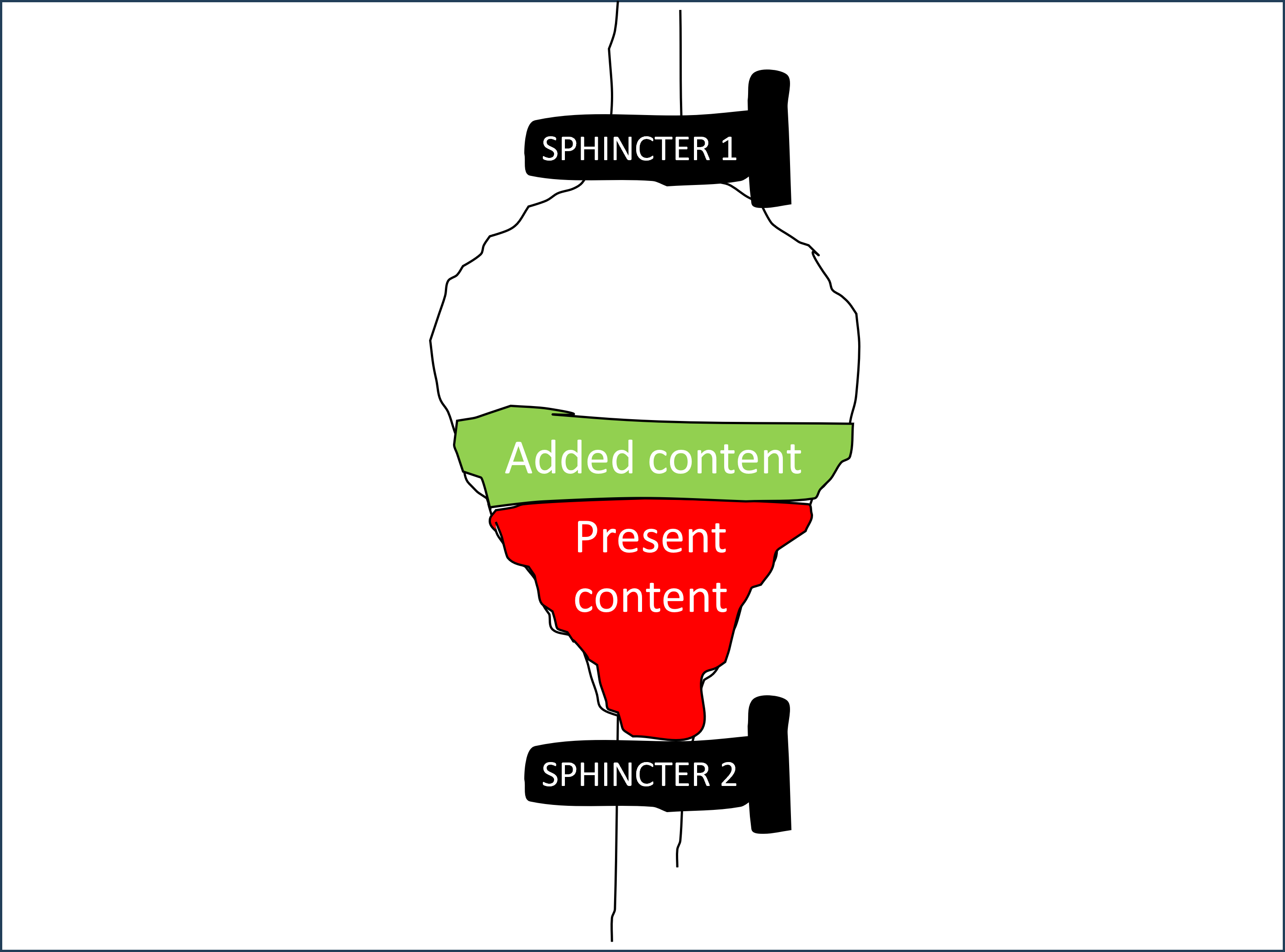
Stomach content volume depends both on how much was in the stomach to begin with, how much is added, and what is going on at the lower end – is the lower sphincter releasing stomach contents to the intestines?
In other words, there’s not just one, but two sphincters in the gut – and the risk of AP depends not only on whether Sphincter 1 malfunctions (and incidentally GER is often unnoticed). We shouldn’t overlook what Sphincter 2 is up to – and that might be even more important since the risk of GER leading to AP correlates with stomach content volume.
OK, with this background, let’s get to the mechanisms by which failing to give treats at the vet’s might hypothetically exacerbate the probability and severity of AP during sedation.
Mechanism 1. The Paradox of Stress: Inhibited Gastric Motility
If you’re not treat feeding or doing other forms of low-stress handling, most animals (about 80% in dogs) get stressed at the vet’s. One of the most well documented effects of stress is that it inhibits gut motility, so whatever was in the stomach is likely to stay in the stomach if the animal is stressed.
In contrast, if you’re successfully counterconditioning, gut motility should be up and running. If you’re feeding small, fluid amounts and keeping fear, anxiety and stress at bay, it could be that the stomach is actually emptying faster than it’s being filled.
Mechanism 2. GERD
Not only is the volume of stomach content potentially larger in stressed animals, but acute stress may also cause Sphincter 1 to dysfunction, triggering Gastro-Esophageal Reflux Disease (GERD) – at least in humans. Since most dogs are frightened on the examination table, this may explain why AP is 3-12 times more common in dogs than people (assuming that the same dysfunction occurs in canines – which admittedly has not been studied, as far as I know.)
Mechanism 3: More animals sedated?
If the animal is stressed (because they’re not exposed to Fear Free handling including counterconditioning), they often need to be sedated in order to be properly examined. I’d expect the percentage of sedated dogs to be larger among non-counterconditioned dogs than dogs that experience counterconditioning during their vet visit.
And since there’s a risk of AP with every sedation (and indeed, perhaps also an increased AP risk in the stressed group), there’s likely more dogs with AP among stressed animals.
In other words, Mechanisms 1 and 2 might aggravate the risks posed by Mechanism 3.
Mechanism 4: More acidic stomach content if fasted – potentially higher risk of damage
The acidity of stomach content increases with fasting time – and high acidity might lead to more tissue damage if AP occurs.
To summarize, there’s absolutely nothing in the current data that suggests that vets should refrain from feeding treats to their patients to avoid AP if they need to be sedated at some point during the visit – at least not if they choose those treats carefully.
The choice of treats.
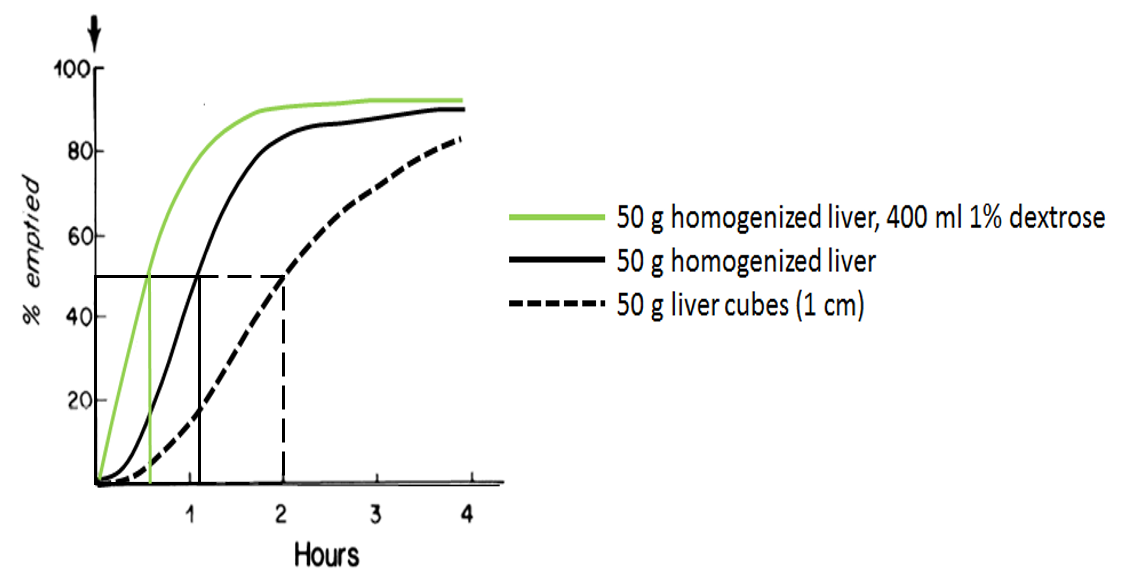
As mentioned, the choice of treats will impact how quick the gut passage is. Half the content may be emptied in 2 hours, just over one hour, or in about half an hour depending on whether a dog has been fed liver cubes, homogenized liver or a rather large suspension of homogenized liver.
Yes, fluids may leave the stomach almost four times faster than solids.
So, if we need to minimize the stomach content volume before sedation occurs, we should choose liquid or fluid treats, that pass through the gut more quickly than solids. We should also ensure that the animal isn’t stressed, and incidentally one of the most reliable ways of doing that is by strategically feeding the animal – counterconditioning.
Theoretically, counterconditioning doesn’t increase the risk of AP – it reduces it.
The choice of sedative – and anasthesia procols.
My research also revealed that a huge factor in the risk of AP in sedated dogs has to do with the choice of sedative – which drug is used to put the animal to sleep. Some are emetic (causes vomiting), and some are not. If possible (and sometimes maybe it’s not), ask your vet to choose a non-emetic option.
Indeed, more recent studies (after my paper was published) show modern anesthesia protocols (for instance, using prophylactic anti-emetics as well as keeping the animal upright during intubation and recovery) have reduced aspiration risks by 10x (!) – making the ‘no treats before sedation’ notion increasingly obsolete in modern, Fear Free practice.
My conclusion is that there are mostly disadvantages with not feeding treats, and mostly advantages with doing so.
If you’re using small amounts of a fluid treat to reduce fear in the veterinary clinic, there is no reason to assume that there is an increased risk of Aspiration Pneumonia (AP) if the animal needs to be sedated. Potentially, the opposite is true: if you don’t address fear, there might be an increased risk of AP.
So, there is no catch 22 in this scenario.
There is no increased risk of Aspiration Pneumonia (AP) when treat feeding to countercondition animals during the vet visit.
In fact, I can think of four reasons why veterinarians should ensure that, unless medically contraindicated, animals should be offered treats during a vet visit. Treat feeding will not solve all problems in the veterinary clinic, but is one powerful tool in the toolbox of prevention, planning and low-stress handling techniques available.
In my opinion, treat feeding should be the norm rather than the exception in the vet clinic.
And luckily, as I’m updating this blog post a decade later, it seems it is nowadays: major organizations like WSAVA (World Small Animal Veterinary Association) now officially partner with Fear Free, meaning treat-feeding is no longer “niche” – it is endorsed by the highest levels of veterinary authority.
… Still, I realize that some of the reasoning in this blog post is hypothetical, at this point. No-one has examined specifically the effects of counterconditioning using treats on the risk of Aspiration Pneumonia – AP.
And again, I’m not a vet, so I can’t give medical advice – consult your veterinarian about Fear Free handling and counterconditioning! Also, there may be other reasons why your vet is hesitant to feed your animal during the visit.
Oh, and if you’re interested in getting a copy of the scientific paper I wrote, just click the hyperlink below to send me an email request (I’m not allowed to share it publicly, but I can send it privately).
***
I teach about behaviour management – if you’re interested in learning more, sign up to get info about future blog posts, free webinars, silly experiments and online courses:
References:
Hinder & Kelly, 1977. Canine gastric emptying of solids and liquids.
Shiun et al. 2006. Preoperative fasting in dogs.
Westlund, 2015. To feed or not to feed – counterconditioning in the veterinary clinic.
14 replies on “Why vets shouldn’t avoid treat feeding in the clinic”
I’ve mostly worked with horses, but as a vet-student I worked at a small animal hospital. I was never taught the fasting because of huge risk during sedation/anaestesia, but because the cat or dog often get nauseous and throws up. The more (solid) food in the stomach, the worse the animal in general gets – and they really do look awful!
There is a potential risk of regurgitation when the animal is under anaesthesia, but I’ve never seen it – and I’ve never heard an experienced vet be nervous about it.
……. but I’ve seen animals get less confident at the vet after they’ve puked hard – so I do find it valid to give less treats before surgery and fast at home. But have pockets full of treats the rest of the time 😉
Horses “cannot” throw up. Anatomically it’s because of how the stomach and eosophagus is connected; when the stomach fills up it will close off to the eosophagus(yes, a bursting stomach is a real concern with colic horses!).
We don’t know if horses get nauseous, but I’ve never seen problems with horses who got lots of treats before sedation. Only problem is if you are to examine the teeth and they are stuck with treats – flushing carrots, grass or hay out is okay, but the treats from the stores, jeeeesh, that can take 1/3 of your good sedation time!
interesting – thanks for sharing! <3
[…] often avoid treat feeding during consultations because they fear Aspiration Pneumonia if they need to sedate the animal. Hypothetically, there could be an increased risk of Aspiration […]
[…] assortment of fabulous treats, in order to bring about this important learning. And there’s no scientific support for the old adage “the animal must fast before sedation, so we can’t feed treats in case we need to sedate the animal” – in fact, it […]
Hi!
As a horse owner I wonder if there is a AP risk at all. As long as the treats come before the shot, there shouldn’t be a problem, right.
I’ve got to ask my vet about this, he did get quite upset when I started feeding treats to make sticking the needle in my horse a bit more easy for her (we have done training with needles and candy before the vet visits).
Interesting anyway!
I haven’t seen AP described as a problem in horses – nor does it seem to be in cats. I’m not a vet, through…
I think for horses there could be an immediate hazard (of maybe rather fear of hazard) of treats getting stuck, but the vet could just wait with injecting the solution until the horse has swallowed.
I am very blessed to have vets that keep a freezer full of bowls with a thin layer of peanut butter spread inside as well as peanut butter covered spoons. The small amount of peanut butter takes a long time to lick off by the dogs building a positive association with the vet and the clinic. My dog into the clinic to have fun with their vet friends.
Interesting that we all love peanut butter, no matter the species. Thinking about nut allergies, though?
Hi!
I wanted to read the whole paper “Shiun et al. 2006. Preoperative fasting in dogs.”
But when I search pubmed and google I can not find it, can you help me and direct me to it?
Kind regards
That was a tricky one, I couldn’t find it first either so I wondered if I had quoted it correctly. But here it is:
http://www.veterinaria.org/revistas/recvet/n010106/050106b.pdf
Your arguments are sufficiently compelling that somebody should do a study and collect data. That’s the only way to really find out. It seems worth it!
I’m still getting the “better safe than sorry” type answer. I’m thinking one easy start would be just to score the fear level of the animal at sedation and once you have a couple of thousand sedations see whether there is a correlation between fear level and the risk of AP. I don’t think anyone dares do the actual experiment of giving treats to dogs before sedation – at least not with privately owned dogs. And since the incidence of AP is so low, that’s the only way I think – the sample sizes need to be vast, so a laboratory experiment is out.
[…] to what many vets have assumed, there’s no evidence to indicate that it should be riskier to feed treats with the purpose of reducing fear in animals about to undergo sedation. There may be other reasons […]