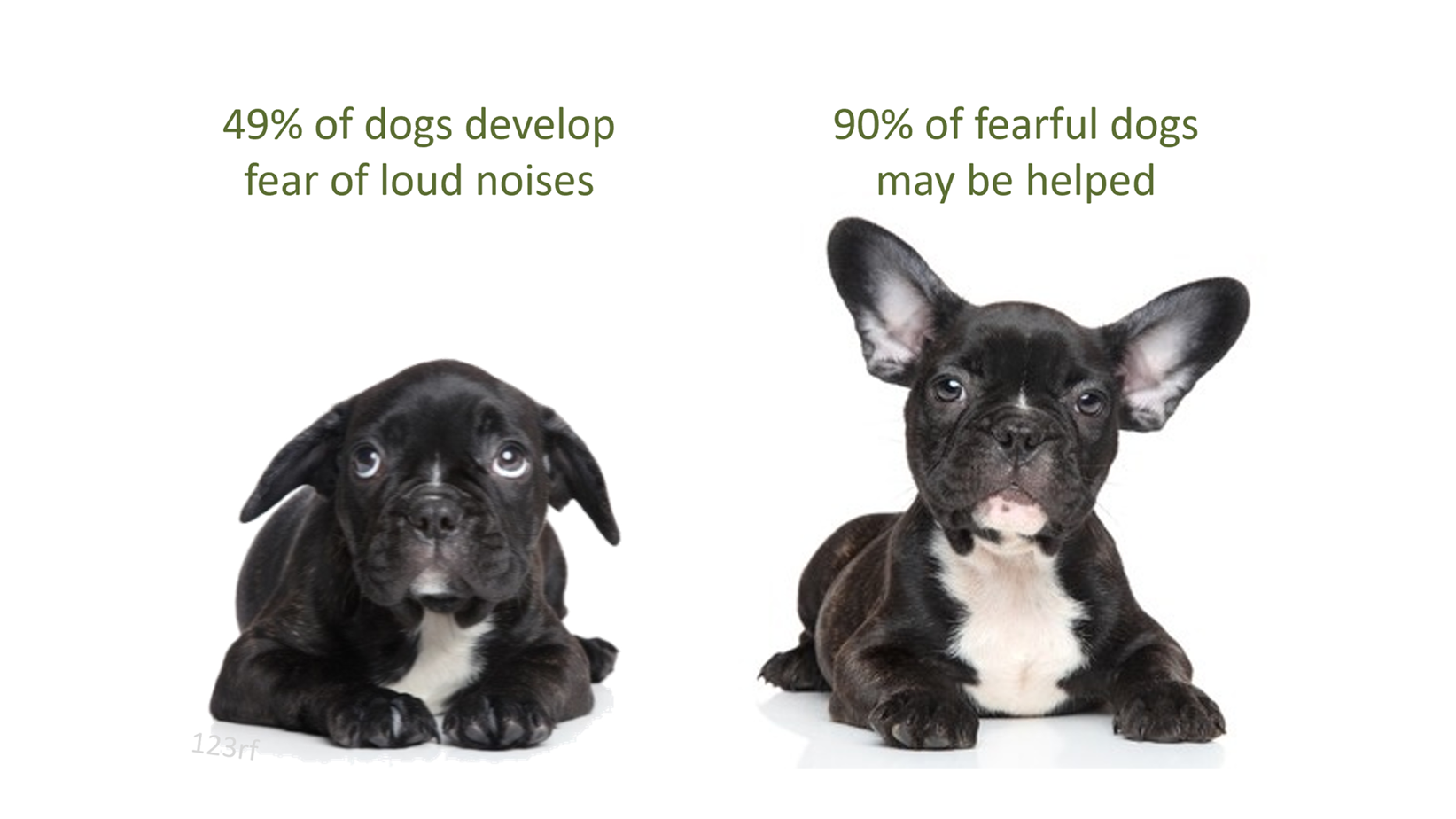
… Is your dog afraid of fireworks? How about thunder?
Keep reading, this blog post contains everything you need to know.
… Is your dog *not* fearful of fireworks, thunder or other loud noise?
Keep reading anyway. That may change, and you should be prepared. What’s more, you can prevent it from ever becoming an issue.
This post is updated about twice a year, last on May 31st, 2026 – look for the “revised” signs in the post to find the latest changes.
It’s the combination of different techniques that produce the best effect (Crowell-Davis et al., 2003: 93%). Nobody’s tried using all the techniques suggested in this blog post, as far as I know.
Is the noise starting already? Jump straight to what to do now.
What follows below is a chapter from my full course Animal Emotions.
To be quite transparent, it’s one of the chapters that has the least practical application when it comes to caring for captive animals, but it is also, hands down, the one chapter in all my online courses that leaves students the most flabbergasted.
And given how the subject of gender identity has become politicized in the last few years, I thought that maybe sharing some very basic facts would be a way to contribute.
There was an article in a Norwegian dog magazine (an English translation is in the comments’ section below) this week, essentially claiming that by delivering an electric shock to a dog a single time as it runs towards a flock of sheep, you can stop it from ever chasing sheep again. Indeed, it gets a diploma to show that it’s “sheep-proofed”. There are no other ways of teaching this behaviour, the article claims, and also, it suggests that it’s a way to increase the overall quality of life of the shocked dogs.
The article implies that a single shock in a single location is all it takes to make dogs sheep-proof forever.
Needless to say, this article has stirred a lot of feelings within the Norwegian R+ community.
And for good reason.
Now, I don’t train dogs myself, but reading through it I found I have four areas of concern:
On this blog, I typically focus on animal emotion, learning and welfare, and on helping people transition away from coercive methods by giving them robust and compassionate alternatives.
But true progress in this field depends on good science. So when a peer-reviewed study publishes a cartoonish caricature of reward-based training and calls it science, it muddies the waters for everyone trying to do better by their animals.
This study has since its publication been cited in some circles as proof that positive reinforcement utterly fails in high-drive predatory contexts. Since it proves nothing of the sort, I feel a lengthy, occasionally nerdy and also somewhat rambling blog post pointing out the most flagrant problems is in order.
In short, the authors found that teaching dogs to refrain from chasing a fast-moving lure was effective in a novel environment in 2/3 of cases when shock-collars had been used during training, however attempting to train the behaviour in a slightly shorter time frame using “food rewards” (50 minutes as opposed to 60 for the shocked dogs) was essentially useless. They also saw no signs of distress or reduced welfare in the shocked dogs, except that all of them yelped in pain at some point.
Many of the chapters of my Advanced Animal Training course don’t lend themselves to be published as a stand-alone blog posts, since they build on each other.
But the chapter below, discussing the Matching Law, does!
***
Matching Law implies that animals (and humans) will do more of the behaviour that leads to the most favoured outcome, but they will keep offering the other, less well reinforced behaviour too, at least sometimes. Matching is affected by reinforcer quality, rate and delay of reinforcement – and response effort.
We use cookies to ensure that we give you the best experience on our website. If you continue to use this site we will assume that you are happy with it.