I’m not a dog trainer.
And so, many dog guardians – or dog trainers – don’t think that I have anything to teach them. They tell me so often enough to warrant an explanation as to why in the world an Associate Professor of Ethology thinks she should be teaching about training.
Hint: the reason I teach is exactly because I’m looking at something different than what a trainer sees.
(Actually, this blog post may as well be called Animal Training is Like Brain Surgery. The species is irrelevant; the biology is the same. Just swap “dog” for “horse” or “husband” as you see fit.)
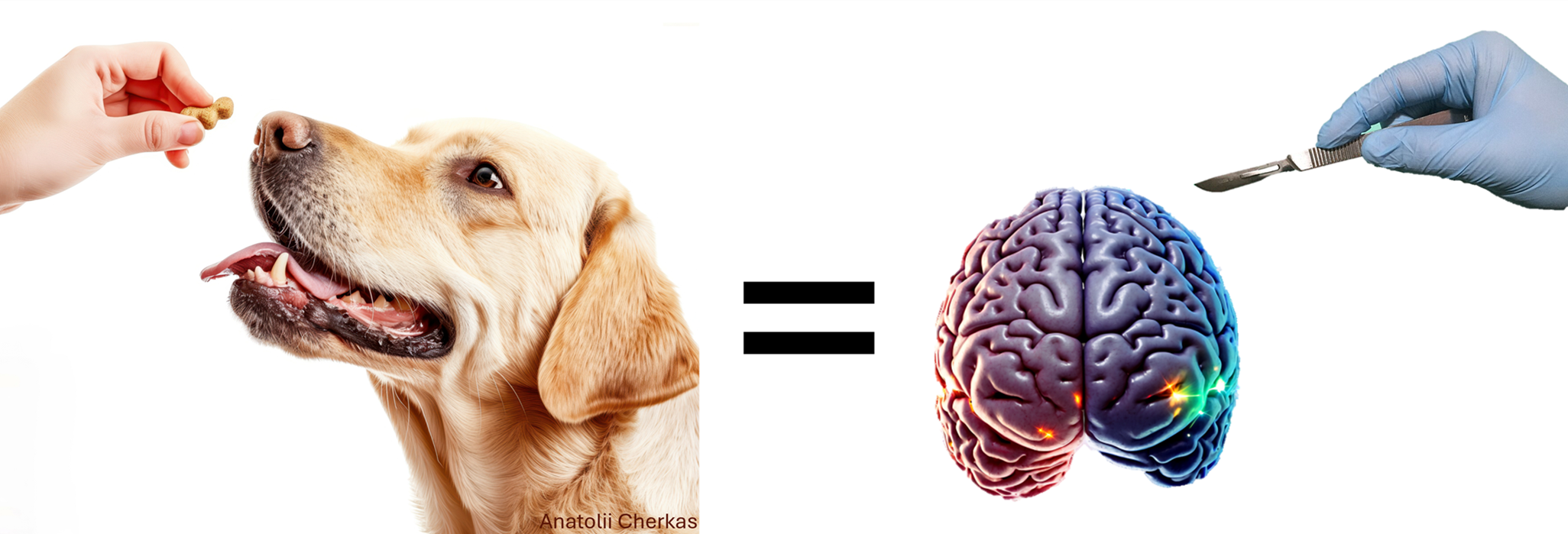
Why the “Toyota” analogy is a delusion.
I’m a sucker for analogies, and here’s what I think is going on: Some people think that learning about dog training is sort of like learning to drive a car.
“Watch a skilled dog trainer in action – that’s how you learn how to train dogs.”
Much as you would want to find an experienced driver to learn how to drive.
Well… Drivers don’t need to be mechanical engineers. They don’t need to know how fuel injection works or the physics of torque. They just need to know which pedal makes the metal box go “vroom.” It’s a manual skill. It’s a mechanical, static process. If the car breaks, you turn it off and park it. It’s an inanimate object, after all.
But here’s the thing: A dog is not a Toyota.
And frankly, the “just copy what that other driver does” approach can blow up in your face when applied to dog training. “Driving” a living, breathing nervous system using only your “gut instinct” and a few tips you saw on YouTube is potentially a recipe for disaster.
Rather, on our quests for useful analogies, I think that dog training is more like brain surgery than it is like driving a car.
Here is why the driving analogy fails and the surgery analogy sticks:
1. You can’t learn it simply by watching.
In driving, once you see someone use the blinker or the brake, you “get” the mechanics. It’s a visible, physical skill.
But in brain surgery – and in animal training – watching the action doesn’t tell you why it’s working.
The training reality: The aspiring trainer might see the skilled trainer hand a dog a treat (the “meatball” approach), but if they don’t understand the importance of timing, criteria and the rate at which those meatballs are delivered, they won’t be “driving” their own dog’s behavior; they’ll just be chucking processed meat and hoping for the best.
2. There’s massive “Under the Hood” requirement.
A driver doesn’t need to understand internal combustion to get to the grocery store. But a brain surgeon must have a solid understanding of things like the cardiovascular system, neurology, and chemistry.
The training reality: Effective dog training isn’t about having the right equipment. It’s underpinned by Affective Neuroscience (the biology of emotions), Ethology (species-specific behavior), and Behavior Analysis (the ABCs of learning).
Trainers who are not familiar with these are just poking at the “brain” of the dog’s behavior, hopefully not accidentally severing a connection.
3. There’s no “Off” switch.
If your car makes a weird noise, you park it. It stays broken, but it stays still.
In brain surgery, the patient is often kept awake. The heart never stops. The brain never stops processing.
The Training Reality: You cannot “pause” an animal’s learning. While a trainer is fumbling with their treat pouch, debating which leash to use, or wondering why their “commands” aren’t working, the dog’s brain is actively forming new, often permanent, associations.
If you don’t understand the underlying learning mechanisms, the why that explains behaviour, it’s as if you’re performing surgery on a moving target.
4. The “Side Effect” Profile (or Why “Quick Fixes” are Dangerous)
If you fix a broken radiator in a car, it doesn’t suddenly make the radio stop working. The systems are modular.
However, in brain surgery, one tiny nick in the wrong lobe can change a person’s entire personality or their ability to walk.
The Training Reality: This is why I advocate so strongly for science-based methods. Some people might address the animal’s annoying behaviour by using a “quick fix” involving punishment – and congrats, the symptom stopped. But the side effect might be a total collapse of the dog’s confidence, a surge in generalized anxiety, or redirected aggression. You haven’t “repaired” the behavior; you’ve just caused collateral damage to the nervous system.
In fact, there are 20 potential problems with punishment – I discuss them here.
Leaving Mount Stupid
As the weird Dunning-Kruger effect illustrates, the less we know about a complex subject, the more confident we tend to feel. We call this state of blissful, confident ignorance being on Mount Stupid.
Many dog people stand there because they’ve had dogs for decades and “it’s always worked before.” But when they realize how much they don’t know about the biological blueprint of our dogs, that’s when they can actually start to help them.
That is why I teach. I teach because I understand how learning happens, and I don’t need to hold the leash to help my students understand the brain at the other end of it.
I discuss these ideas, and describe my courses, here:
Did the list of blog-posts-Karolina-has-written-when-annoyed peak your interest? Find them here.
Curious about my courses? Find out more here.
I typically share the framework of each course in a free online training series during the weeks leading up to the enrollment period. Just sign up below, and I’ll keep you posted on these learning opportunities!
24 replies on “Dog training is like brain surgery”
I really enjoy your topics… I feel like i grow so much more listening or reading from you.
Do you share your blogs on audio by chance?
unfortunately, no, I don’t..!
Once again you have given us excellent information to think about and analyze. You don’t have to be an animal “trainer” to understand how to work with animal behavior. Personally I believe someone like you can do more to help animals (dogs) to adjust to the human world than many “trainers” who only deal with the behavior without understanding the reason for /source of that behavior. Your way is a more compassionate and humane way.
Thanks Stella! So glad you enjoyed the post! 🙂
Hi Karolina
Thank you for sharing your knowledge so generously, it has helped me understand and help my fearful rescue dog.
Anyone who says you can’t help because you’re not a trainer has not realised the importance of working to improve the dog’s emotional state and confidence. Actually way, way more important than training in my experience.
Thanks for the endorsement, Andy! 🙂
Karolini, I love this post! I totally agree with you and I got this firsthand experience with Kay Laurence whose « under the hood » knowledge and skill still admire!
Thank you for sharing your thoughts and all the best to you!
Glad you enjoyed it, Kristina! 🙂
I love this blog! The analogy is perfect. I have learned so much from you, especially from the Animal Emotions course and am really grateful that you share your knowledge, wisdom and experience in such a delightfully accessible way!
Hi Pip – so glad to hear that!
Hi Karolina, I feel your frustration and it definitively goes into the same direction as the “I tried that already, it does not work” approach that you often get from handlers. Yes, it might not have worked before, because… your timing was wrong, the distraction was too high, the motivation was to low…..
What ever. So no, it’s not the brain surgery that does not work, it’s the surgeon who is not good enough and should get more training. Thank you for your amazing training!!!
Hi Irmgard – glad you found this helpful! 🙂
My standard poodle had lived in the kennel where he was bred until I got him at 9 months of age. He had some behaviours which I think were due to lack of exposure to the types of things a dog raised in a home would encounter such as extreme reactions to his reflection in a shiny surface. I have trained him using positive reinforcement methods, first in live classes then continued with online classes with Susan Garrett during covid. He is generally very well behaved, has many human friends w
that he seems to love, gets along well with other dogs. However, very occasionally, perhaps twice a year, without warning, he will bite a stranger even when he is on leash. I reward him for walking past people without reacting but cannot totally eliminate this behaviour. Not sure if he is reacting to something he detects in the person or if he may be reacting to my anxiety. I try to greet people in a friendly fashion to show him they are friends. He never growls a warning and I have not been good at recognizing his body language. I recently found a podcast by llana Reisner, a veterinary behaviorist, in which she mentioned breeding for certain traits, like looks, can result in changes to temperament. Her main focus was dogs biting children and her advice was to supervise at all times. Could you please talk about this type of reactivity in dogs and how to modify this kind of behaviour?
Hi Joyce, I can see how his unpredictable behaviour feeds into your anxiety! Have you explored Grisha Stewart’s BAT concept? https://grishastewart.com/bat-overview/
Also, I would consider teaching him to wear a muzzle. That way he can’t bite – which should remove your anxiety, and the risks involved.
Thank you Karolina, I will look at the link. I have put a muzzle on him. I bet much appreciate your reply. It is difficult to find information on this topic. Best regards.
Hope it helps, Joyce! <3
Hi Karolina
I really appreciate your perspective on the topics you discuss – your against-the-grain point of view is exactly what modern society needs, not only in the dog training field.
As for the analogies, here’s my view:
– You can’t perform surgery of any kind without prior theoretical knowledge.
– You can drive a car without knowing how it works, although it’s useful to understand what’s under the bonnet (e.g. topping up fluids or changing a tyre).
– However, you can’t drive on the road without passing your theory test.
– Similarly, you can’t train dogs without understanding how their brains work—just as you can’t effectively persuade people without some basic knowledge of human psychology.
Thank you
Monica
Hi Monica, thanks for chiming in! 🙂 Glad you enjoyed the post! 🙂
1. I find driving a car harder than training dogs. I learned dog training from books and internet. And I can’t imagine learning to drive a car like that. Changing a lightbulb in my car – yes. Driving – nope!
2. „ Actually, this blog post may as well be called Animal Training is Like Brain Surgery. The species is irrelevant; the biology is the same.”
Really irrelevant? What if the species I choose doesn’t even have a brain? What can you tell us about earthworm training? Can it be done or not?
Point taken, the biology will be different, that was an oversimplification! As to earthworms, operant learning has been demonstrated: https://link.springer.com/article/10.1007/BF03396009#:~ as well as classical conditioning: https://pubmed.ncbi.nlm.nih.gov/31100328/
If you can classically train your white bloodcells (was that in your Advanced Animal Training course?), then why not earthworms? 😀
And that was my guess tat operant conditionning might work as well. But it’s good to know the data, and that someone actually checked it.
Thank you for the links!
y’welcome! 🙂
Loving this! The best work often comes out when we are annoyed 🙂 I just made 2 Youtube videos using that same frustration energy 😀
haha! Good for you!